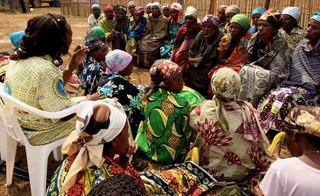
In the village, it is culture that is the law. And yes, girls are second class citizens at best. Basically, girls are for marriage. The father gets a dowry when marrying off his daughter, and she leaves his family and joins her husband’s family. She basically becomes property of her husband’s family. (…) Women don’t have rights to ownership, even to inheritance, so they are dependent on anyone who will give them any consideration for livelihood — says Neema Namadamu, Founder & Executive Director Hero Women Rising & Synergy of Congolese Women’s Associations in an interview for Berliński Tygiel (Berlin Melting Pot).
Berliński Tygiel: Hunger, lack of access to medicine and healthcare, sexual violence against women – for years, these issues have been mentioned in the context of the conflict in eastern DRC. What is the biggest challenge from your perspective as the founder of an organization supporting women in the eastern provinces of Congo?
Neema Namadamu: First, let me mention that we have Mama Shujaa (Hero Women) Centers in the capital of our province as well as the remote isolated area of our province called the Haut Plateau, or high plains, which is at forested elevations of 7,000 feet and higher.
In the capital, men generally take responsibility as head of household and primary provider, while in the Haut Plateau, men are head of household, but women are the primary providers. In the city, there are services like running water, stores for food and pads, hospitals to have their babies, and more opportunities for commerce. In the remote areas, women provide water for the household by carrying jerry cans from streams, forage for firewood to cook and provide heat, and from their gardens can have some small commerce to be able to buy soap and salt. But there are no pads for menstruation. Hospitals and clinics are generally very far and poorly staffed and supplied. Also, insecurity in the isolated areas can mean rape, or even death when going out to fulfil your daily responsibilities.
Our organization is one of only about three local organizations still operating in the midst of the ongoing conflict
The biggest challenge for women is war, and because of that, trauma, hunger, hopelessness, and then the issue of making it though each day with what presents for each family.
For women and girls, no matter the circumstance, they can’t stop to have periods and can’t stop to be pregnant. Just because there is a war doesn’t mean they can say, “I will wait to have my baby when there is peace.” In the Haut Plateau, where the war has raged for over 8 years, they live in concentration camps called Internal Displaced Persons camps for security reasons, where they can’t have access to food, medicine, pads, etc. And militia soldiers are looking for comfort so the women and girls can’t venture out to try and source supplies, or they will be raped and worse. And even if supplies can be found, they are very, very expensive.
In the remote area of our province, about which the blog was written, all international organizations left a long time ago because of the war, because of insecurity in the remote area. Our organization is one of only about three local organizations still operating in the midst of the ongoing conflict. In the capital, there are some big international organizations who still have offices, like Red Cross and a few others, but they are not really working because of the war and because the government has forced the banks of the eastern provinces to be closed.
BT: Speaking of international organizations, what difficulties or obstacles are associated with their work in the field, especially in the east of the country?
NN: To get to the root of your question about international organizations and why has there been no change even though there have been many operating in the region for 30 years, it is mostly because of corruption. International organizations need to partner with local organizations to implement their programs. Somehow there is a network affiliated with Civil Society that lobbies the Int Orgs and coerces the project manager of the Int Org to give them the project grant, allowing the project manager to keep half of the fund, and then the local org will do the reporting and photos to turn into the Int Org without actually accomplishing anything. This climate has cultivated a situation where “program beneficiaries” are simply paid attendees who receive a t-shirt, submit to photos, and walk away with up to $10 to feed their families. So, the dollars spent by international organizations never touch a problem. The dollars only support the organizational infrastructure.
A widow is dependent on her husband’s family for her survival, so she is pretty much a servant to their whims
BT: Apart from the war and the ongoing conflict in the east of the country, what is everyday life like for women in eastern DRC, and are there differences in how women are treated in rural areas and in cities? Your organization’s website mentions, for example, that a woman can be bought for two cows, that girls are not respected, and that they can be abused without any consequences.
NN: Yes, the situation is different for girls in the capital versus those in the villages. In the city, a much larger percentage of girls go to school and choose their mates. In the city, there are governing laws regarding rape and other behaviors, largely enforced because of the density of the population where not much can be done in secret, versus the wide-open spaces of the remote Haut Plateau. In the village, it is culture that is the law. And yes, girls are second class citizens at best. Basically, girls are for marriage. The father gets a dowry when marrying off his daughter, and she leaves his family and joins her husband’s family. She basically becomes property of her husband’s family. If her husband dies, she can be raped by any family member and the resulting children will be said to be the child of the deceased husband, so no accountability or child support. A widow is dependent on her husband’s family for her survival, so she is pretty much a servant to their whims.
Yes, if a girl is raped, and if she is lucky, she will be wedded to her rapist. But if not, especially if she bears a child from the rapist, she will be stigmatized for life and socially ostracized in many instances as a result. Women don’t have rights to ownership, even to inheritance, so they are dependent on anyone who will give them any consideration for livelihood. Typically, it will be men who want sex and will do a little something for the widow, so she ends up having many children from different fathers, none of the children bearing the father’s name, while she just tries to survive and provide for herself and her children.
That is much of my work – to change that paradigm. Our programs are geared toward women and girls but include advocacy that targets whole communities, sensitizing them to the rights and value of women and girls to the family and communities. We have a school, we have programs that teach women how to start their own business with little or no money, we have vocational training programs, we make and distribute thousands of washable, reusable feminine hygiene kits, we have a Food Security program with 19 food cooperatives, school scholarships for orphans, etc.
Education is a key for life. I was fortunate to get an education, probably only made possible because I contracted polio as a little girl and my illiterate Mom was hoping that with an education, I could somehow make a way for myself. Which I did
BT: An important part of your organization’s activities is education, both basic and vocational, as well as education that enables people to use the internet, for example. From my conversation with Jürgen Daldrup, who runs schools for children in Congo, I know how difficult it can be to get an education in the DRC.
NN: Education is a key for life. I was fortunate to get an education, probably only made possible because I contracted polio as a little girl and my illiterate Mom was hoping that with an education, I could somehow make a way for myself. Which I did.
Without an education, the world would not even know I exist, let alone I would have a voice that could be heard. It is why I am so passionate about education. You know I have many friends and relatives who didn’t go to school. One reason is because it cost money in Congo, and we are an impoverished population, so expenses must be prioritized, but also because they didn’t understand the benefits they would gain. Especially for women and people with disabilities. Because with an education, there are no women, no men, no people with disabilities – everyone is equal. When you learn globally, you can contribute your best. It can be any disability or gender, but with an education, the whole world can gain from your experience and expertise.
You know, when you are talking about education, Jürgen’s organization is doing a big job. Education is like taking the second step in life; you are born, then the second step is to have an education. Too many miss out on that. When Jürgen and I get together, we talk about education. I know what he is doing. It is a big deal, not just for Congo, but the world becomes one.
Let’s talk about girls. As I answered you above about girls not being given value, how they are neglected by culture. That’s why I really focus on girls. But education for all girls and boys in DRC is very necessary. With what we are experiencing now in DRC regarding the war, we see how these young boys are being used by militias, giving them guns and drugs. We also see the same situation in mining companies. And that is why I am passionate about educating our youth, not giving them guns but give them a notebook and pen instead of drugs. That is my vision for Congo.
As I mentioned above, the father of a girl gets a dowry to give her to the family of the boy she will marry. The father will use that dowry to educate his sons, while his daughter got only a minimal education, if any. That’s why we have a K-9 school, each year adding a grade. Our permanent facility was ravaged by rebel militias, so we built temporary classroom structures in a nearby IDP camp to house the school. We also have an orphan education program with 40+ students, educating children from kindergarten through university, with 13 now in university, and with three female doctors and two female lawyers having already graduated.
BT: Neema, you are an influential woman with vast experience, including in politics. Why is it impossible to bring peace to eastern Congo? What is preventing a compromise from being reached so that people can live in peace? Congo has enormous natural resources, which alone should be enough to enrich the country so that people do not go hungry and do not have to flee.
During the time of our colonization, our colonizer, King Leopold of Belgium, killed off half of our country’s population as slave labor. Many that he didn’t have killed had their hands chopped off for one reason or another
NN: I am not nearly as influential as I want to be. It is not influential but vulnerability. With this vast experience, and with my education, I see how my country is in a bad situation. Our country suffers from a lack of education, from a lack of knowledge, of discernment, and from a lack of understanding history, our history.
You know that during the time of our colonization, our colonizer, King Leopold of Belgium, killed off half of our country’s population as slave labor. Many that he didn’t have killed had their hands chopped off for one reason or another. Until today, Belgium has offered no apologies, no reparation, nothing. And does our government know that? Do they get that? Do they know that history has a way of being repeated itself because those who ignorantly allow it to repeat itself?
The world is in this second phase of global modernization, moving away from fossil fuels to green electricity and so on. All of the material needed for these things is in the DRC. That puts us in a vulnerable position. We have what the world wants but have inept leadership. The plunder of these natural resources does not benefit the Congolese people, but the international community while our leaders line their ignorant pockets with some USD.
Congo and its people suffer dearly from a lack of education, a lack of understanding, a lack of wisdom. Its population continues to put up with rigged elections and leaders who keep our country in the basement of the Human Development Index. Our people are fleeing this beautiful, wealthy country because of the continuing conflicts, the associated poverty, and a lack of any real vision of our leadership.
So that’s why I say, I don’t feel influential. It seems like I’m not able to accomplish anything to change this paradigm. I feel more and more vulnerable every day. We operate our programs to help in any way we can, because that is all we can do. We do what we can do, because we love our sisters and brothers, we love our country, and we know there is a bright future for us, if we can only find our way. I invite you to come to lend your influence together, we might make a difference, my sister.
My second shock was to realize that women who are raped, due to culture, have no possibilities, no resources, so continue to live in the very communities in which they were raped, because there is no consequence for their rapist, no justice for them
BT: What has shocked you the most during your many years of working with women living in the DRC? Was there a situation that particularly stuck in your memory?
NN: You know, when I was given the post as advisor the minister of gender and family in Kinshasa, I was thinking it would be like a paradise in the capital of our country. But I saw the women with disabilities living outside. Each day on the way to my office I would pass by the Social Affairs building where I saw so many women with disabilities living on the sidewalk with her children. My second shock was to realize that women who are raped, due to culture, have no possibilities, no resources, so continue to live in the very communities in which they were raped, because there is no consequence for their rapist, no justice for them. They must live with their trauma, perhaps seeing their rapist every day, perhaps being raped by him again and again, and there is nothing they can do. That is the life for women, especially in rural DRC. It’s a heavily patriarchal culture and the idea is that women are for sex, and they can have you anytime they want and there is nothing you can do.
BT: What would be the DRC of your dreams? What would it look like?
NN: The DRC of my dreams would be an educated country with its population feeling accountable, knowing and taking their own rights and responsibility in hand.
Interview by: Olga Doleśniak-Harczuk
Neema Namadamu is an advocate for peace and a women’s rights and disability rights activist in the Democratic Republic of the Congo (DRC). In 2012, Neema founded Synergy of Congolese Women’s Associations (SAFECO), a forum to foster collaboration among women-led NGOs to collaborate on their peace, rights, and development agenda. The group of women coming together decided to give their movement a name, and collectively began calling themselves the Maman Shujaa, or Hero Women, in Swahili. As a result of her work, Neema has received numerous awards and accolades, including being named “Architect of Peace and Civil Society Activist,” by Vision Barza (a Great Lakes regional peace organization) (2013); “Africa’s Most Influential Woman,” by South African-based Celebrating Excellence in Organizations (2014); “1 of 14 Fierce Women’s Rights Advocates To Watch,” by Women Thrive Worldwide (2014); one of “100 Most Inspiring Women,” by SALT Magazine (2015). Neema was spotlighted as an activist by Nobel Women’s Initiative (2014). She was featured in the “Unsung Heroes in the Face of Evil” exhibition in Rotterdam, Netherlands (2014), and became one of the faces representing Women’s Transformative Leadership in Africa, as depicted on the cover of MasterCard Foundation’s 2018 study. In 2018 Neema received the Meredith McRae Empowerment Award from the International Women’s Forum of Southern California.In 2023, the BBC listed Neema among the 100 Most Influential and Inspiring Women in the World.
Official site: https://www.herowomenrising.org/
Photo: Meeting with women leaders at the Itombwe Mama Shujaa Center / Neema Namadamu